
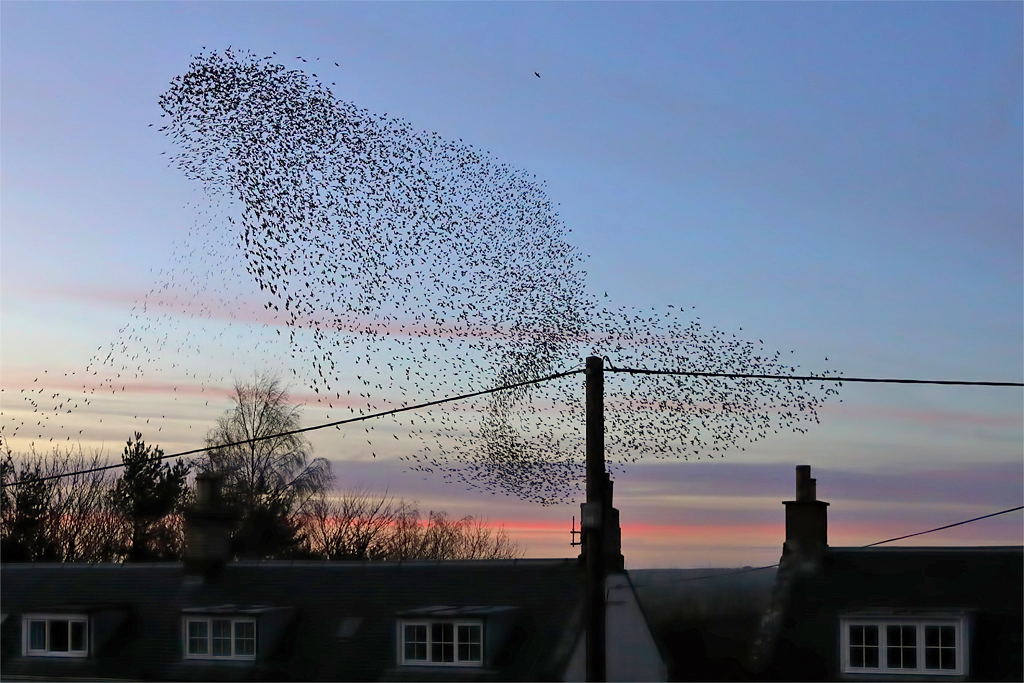
- Why the shapes form
- Local rules, global order
- Six neighbours, not six metres
- Turning waves across a flock
- Where to see a starling murmuration
- Pressures and limits
- References
Why the shapes form
A starling murmuration is a pre-roost gathering where thousands of European starlings (Sturnus vulgaris) wheel and fold above a shared night roost near dusk. Small foraging groups converge, merge, and test the air before dropping to reeds, piers, or woodlands. The result is a continuous surface that stretches, curls, and compacts without breaking. Field organisations describe peak displays on cold, calm evenings in mid-winter when regional numbers swell.12
Local rules, global order
For years, models assumed each bird followed others within a fixed distance. High-resolution 3D reconstructions from the STARFLAG project in Rome overturned that idea. Starlings interact topologically: each bird tracks a fixed number of nearby neighbours regardless of the changing density of the flock. This single change explains how patterns remain coherent when the group stretches or compresses.34
Six neighbours, not six metres
STARFLAG’s measurements show each starling aligns with about six to seven neighbours. The number stays roughly constant even as spacing changes, which is why structure and reaction speed hold up when the flock dilates. This topological rule outperforms metric-distance rules in preserving group cohesion under disturbance.34
Correlations in velocity fluctuations are “scale-free” across the flock, meaning the range of mutual influence grows with flock size rather than saturating at a fixed distance. That keeps the entire group responsive to a predator or wind gust, not just a local cluster.5
Turning waves across a flock
When a murmuration turns, the change does not diffuse slowly. It travels as a coherent wave with little loss, so the rear birds start turning soon after the front birds, even in large flocks. Field data suggest typical cruising speeds around 7–12 m s−1, yet directional information propagates faster than an individual’s speed because it is a signal, not a body motion. This matches a symmetry-based theory that treats orientation as a conserved quantity during the turn.66
Where to see a starling murmuration
Look for open roost habitats such as reedbeds, piers, bridges, or groves. In the UK, numbers peak from November to February when migrants join residents. Arrive 30–45 minutes before sunset on calm, cold days. Watch for small bands streaming toward a fixed point, then condensing into a cloud above the roost. Keep distance, avoid shining lights, and stay after the main display as the late drop can be dramatic.12
Pressures and limits
The size and frequency of murmurations vary with weather, food, and regional populations. In some sites today, flocks reach hundreds of thousands, while historical peaks ran into the millions. Shifts in agriculture, food availability, and wintering routes influence where and when large gatherings occur. Displays can also shorten or vanish on wet and windy evenings as birds drop straight to roost.9
References
- RSPB. “Starling murmurations: what, when, where.” https://www.rspb.org.uk/whats-happening/news/starlings-murmurations ↩︎ ↩︎
- Lancashire Wildlife Trust. “Starling murmuration facts.” https://www.lancswt.org.uk/blog/starling-murmuration-facts ↩︎ ↩︎
- Ballerini et al. 2008. “Interaction ruling animal collective behavior depends on topological rather than metric distance.” PNAS. PDF: https://www.pnas.org/doi/pdf/10.1073/pnas.0711437105 ↩︎ ↩︎
- Cavagna et al. 2008. “STARFLAG handbook / empirical study of large, naturally occurring starling flocks.” arXiv: https://arxiv.org/pdf/0802.1667 ↩︎ ↩︎
- Cavagna et al. 2010. “Scale-free correlations in bird flocks.” PNAS preprint: https://arxiv.org/abs/0911.4393 ↩︎
- Attanasi et al. 2014. “Information transfer and behavioural inertia in starling flocks.” Nature Physics. PDF: https://www.nature.com/articles/nphys3035.pdf ↩︎ ↩︎
- Walter Baxter (2020). “A starling murmuration at Eyemouth.” Wikimedia Commons image page: https://commons.wikimedia.org/wiki/File:A_starling_murmuration_at_Eyemouth_-_geograph.org.uk_-_6378655.jpg ↩︎
- “Winter Starling Murmuration | 4K | Discover Wildlife” (YouTube). https://www.youtube.com/watch?v=98ZzHACTy1Q ↩︎
- The Guardian. “Weatherwatch: It’s murmuration time again” (Dec 2024). https://www.theguardian.com/news/2024/dec/19/weatherwatch-its-murmuration-time-again ↩︎
