
- Why beetles make light
- A photon from chemistry
- Nitric oxide as the switch
- Lantern optics and color
- From forests to the lab
- Can cities keep the glow?
- References
Why beetles make light
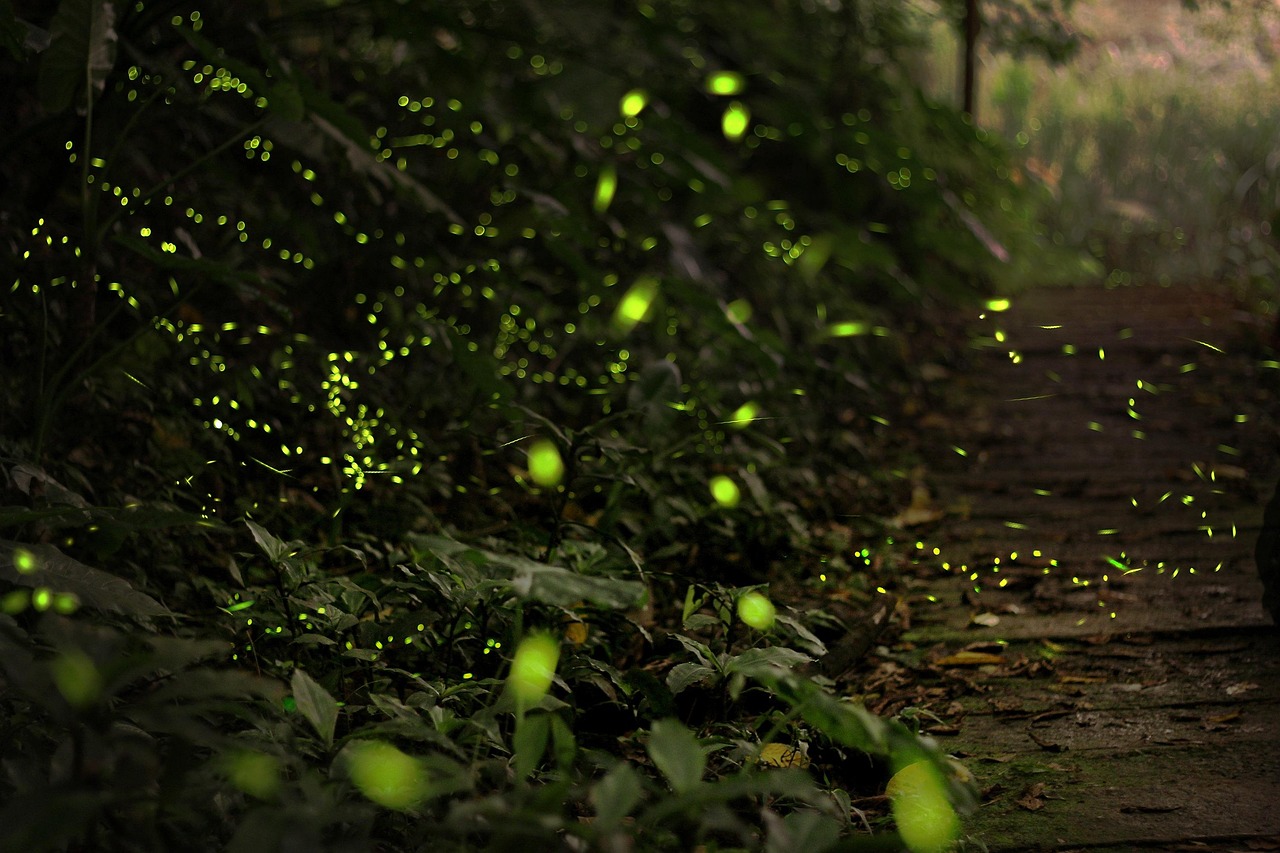
Across more than two thousand species of lampyrid beetles, light is language. Adults of many species trade precise flash patterns to find mates; larvae glow steadily. Some predators copy a rival’s code to lure victims, while bitter defensive compounds make a steady glow an honest warning. Night after night, the forest quiets and—sometimes—entire populations pulse in near perfect unison.1
A photon from chemistry
Inside light-producing cells (photocytes), an enzyme called luciferase grips a small molecule, luciferin. First, luciferin is “primed” by ATP to make luciferyl‑AMP. Oxygen then forms a high‑energy intermediate that collapses to excited oxyluciferin—which releases a visible photon as it relaxes. The luciferase pocket and its microenvironment tune the photon’s energy, so the glow falls in the yellow‑green band our eyes sense well at dusk.2

Nitric oxide as the switch
Quick flashes require a quick gate. Fireflies briefly flood the lantern with oxygen by using nitric oxide (NO) to pause mitochondria’s oxygen consumption. When NO spikes, more O2 reaches luciferase and the lantern brightens; when NO falls, mitochondria reclaim O2 and the light drops. Nerve signals set the rhythm, but oxygen gating is the fast switch that makes crisp on–off pulses possible.3
Lantern optics and color
A reflector layer behind the photocytes is packed with uric‑acid granules that bounce photons outward, boosting brightness without extra chemistry.4 Emission color depends on luciferase and its environment; a common North American species, Photinus pyralis, peaks near 562 nm (yellow‑green).5
From forests to the lab
Firefly luciferases are now workhorse reporters. Engineered variants emit distinct colors so biologists can read two processes at once with a single luminometer—one of the simplest, most sensitive assays in molecular biology.6
Can cities keep the glow?
Habitat loss, bright night lighting, and pesticides threaten many firefly populations worldwide.7 You can help: keep outdoor lights warm‑white and shielded, use timers or motion sensors, leave patches of moist leaf litter for larvae, and avoid broad‑spectrum yard treatments.8
References
- Synchronous fireflies in Great Smoky Mountains National Park — YouTube. https://www.youtube.com/watch?v=6LGGATKBda0 ↩︎ ↩︎
- Branchini B. Chemistry of Firefly Bioluminescence — Photobiology.info. https://photobiology.info/Branchini2.html ↩︎ ↩︎
- Trimmer B. A. et al. (2001) Nitric oxide and the control of firefly flashing. Science. PDF: https://www.science.org/doi/pdf/10.1126/science.1059833 ↩︎
- Goh K‑S. et al. (2013) Uric‑acid spherulites in the reflector layer of the firefly light organ. PLOS ONE. https://journals.plos.org/plosone/article?id=10.1371/journal.pone.0056406 ↩︎
- UniProt P08659 — Photinus pyralis luciferase entry (peak emission ~562 nm). https://www.uniprot.org/uniprotkb/P08659/entry ↩︎
- Hattori K. et al. (2018) Dual‑color firefly luciferase reporter assay. Scientific Reports. PDF: https://www.nature.com/articles/s41598-018-24278-2.pdf ↩︎
- Owens A. C. S., Lewis S. M. (2020) A global perspective on firefly extinction threats. BioScience. https://academic.oup.com/bioscience/article-abstract/70/2/157/5715071 ↩︎
- Xerces Society — Firefly‑friendly lighting practices. https://xerces.org/publications/fact-sheets/firefly-friendly-lighting ↩︎