

- What crown shyness looks like
- How trees keep their distance
- Benefits of leaving sky gaps
- Where and when it appears
- What scientists still do not know
- References
What crown shyness looks like
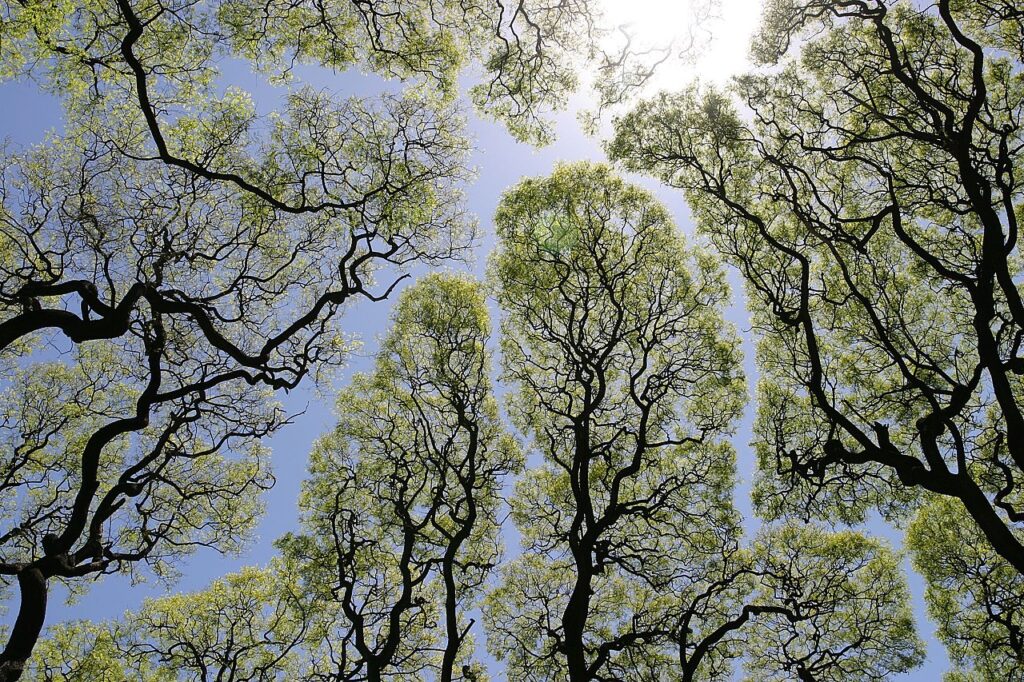
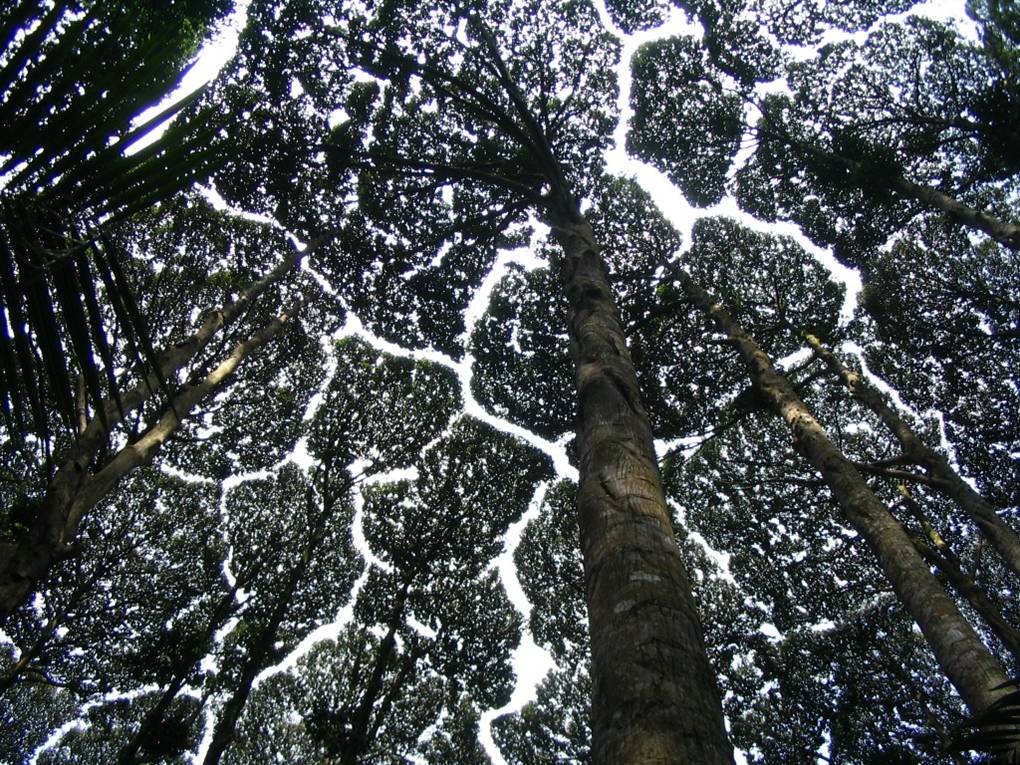
Look straight up in some forests and you see narrow rivers of sky snaking between neighbouring crowns. The leaves form blocks or islands and the gaps between them trace a clean, crack-like network that looks almost designed. This pattern is called crown shyness, and it appears when the crowns of fully stocked trees stop growing just short of one another, leaving channel-like gaps instead of a continuous canopy.1
Not every forest shows crown shyness. Where it occurs, it is usually most obvious in stands where trees are similar in height and packed closely together. Some of the best known examples involve tropical dipterocarps such as Dryobalanops aromatica in Malaysia, certain eucalypts, lodgepole pines and black mangroves, although multi-species “jigsaw” canopies also exist.1
How trees keep their distance
One of the earliest explanations focused on simple physical contact. In windy sites, adjacent crowns sway and collide. Twigs and young shoots get scraped, broken or stripped of buds at the exact points where branches would otherwise overlap. Field work in Costa Rican mangroves showed that frequent wind-driven collisions prune back the outermost shoots of neighbouring trees, leaving a lasting track of empty space between their crowns.3
Experiments in managed stands add support to this abrasion idea. In some conifer forests, researchers physically prevented neighbouring crowns from colliding, for example by tying stems or shielding branches. Over time the canopy gaps largely closed, and crowns expanded farther sideways than in unmodified plots. In wind-exposed stands, especially where tall, slender trees of similar height share the canopy, repeated collisions keep lateral growth in check and maintain crown shyness patterns.4
Another line of work suggests that trees avoid each other without needing to crash together first. Plants can detect nearby neighbours through changes in light quality, particularly the ratio of red to far-red wavelengths and the direction of blue light. When a leaf senses the backscattered light from another canopy, the tree can redirect growth away from that neighbour and invest more in vertical extension.5 In Malay camphor trees, for example, the growing tips appear to slow or stop as they approach the shaded edge of a neighbour’s crown, even when there is little sign of mechanical damage.
Work in Arabidopsis thaliana adds a further twist. When this model plant grows among close relatives, it tends to place leaves to avoid shading kin, yet it is less generous with unrelated individuals. This behaviour depends on several photoreceptor systems, the same classes of sensors that mediate shade avoidance in taller trees.6 Crown shyness in some forests may therefore emerge from many individual branches following simple, light-guided rules about where not to grow.
More recently, high resolution laser scanning of forest canopies has shown that neighbouring crowns in shy stands often fit together like complementary surfaces. Where trees are tall and slender, their crowns grow into shapes that minimise overlap with neighbours while still filling available space. The resulting canopy is neither random nor perfectly tiled, but a statistically consistent pattern of near misses.7
Benefits of leaving sky gaps
Crown shyness looks dramatic from below, but from the tree’s point of view it may be a compromise that improves survival. The most direct benefit is avoiding structural damage. Limiting collisions reduces broken twigs and split branches, especially in flexible, fast-growing crowns that sway strongly during storms. Less damage means less opportunity for decay fungi and other pathogens to enter through wounds, and the tree keeps more of its leaf area intact over many years.9
The gaps also change how resources flow through the forest. Where crowns do not fully interlock, more light reaches the understory in narrow shafts and patches. That extra light can support a richer mix of shrubs, seedlings and ground plants, which in turn supports more insects and vertebrates.10 Rainfall is channelled through the open lanes, helping water reach the soil rather than being intercepted entirely by outer foliage. By moderating shade, wind and moisture, crown shyness can make a dense stand function less like a solid roof and more like a selective filter.
Some studies and reviews argue that the gaps may slow the spread of leaf-eating insects, parasitic vines and foliar diseases, since there is less continuous contact between neighbouring crowns.8 Even small separations can reduce the chance that a caterpillar, liana or fungal infection can move directly from one tree to the next. In that sense, the “social distancing” metaphor that often accompanies popular images of crown shyness is not entirely off the mark.
Where and when it appears
Crown shyness is not a universal forest feature. It shows up most clearly where trees are crowded, of similar height and age, and exposed to enough wind to nudge crowns against each other. That includes dipterocarp stands in Southeast Asian rainforests, black mangroves in Central America, lodgepole pine forests in western North America and even some urban plantings of oaks and eucalypts.1
Within a single stand, the pattern can change over time. In young, flexible canopies, branches respond quickly to abrasion or shading and gaps are often sharp. As trees age, differential growth, mortality and storm damage can blur the edges. Mixed-species forests complicate things further. Some species seem “shy” only toward their own kind, while others maintain spacing with neighbours of many species. Structure, species identity and local climate all interact to decide whether a particular forest shows the characteristic puzzle of sky or an almost continuous green ceiling.7
What scientists still do not know
Despite a century of observation, there is no single agreed cause for crown shyness. Long term measurements and modelling suggest that mechanical abrasion, light-guided growth and species-specific physiology all matter, but not in the same way for every forest. In some stands, preventing collisions is enough to erase the gaps, which points strongly to wind-driven pruning. In others, careful searches find little physical damage at crown edges, and light sensing provides a better fit to the data.8
Current work uses tools such as terrestrial LiDAR, canopy robots and high resolution time series to track how individual branches move and grow in three dimensions. Those approaches are starting to tie broad patterns in the canopy back to local rules at the scale of a bud or leaf. The emerging picture is that crown shyness is not a single behaviour. It is a recurring outcome that different tree species can reach through different combinations of mechanics, sensing and competition, all shaped by the wind and light environment they share.
References
- “Crown shyness” overview and species list, Wikipedia. https://en.wikipedia.org/wiki/Crown_shyness ↩︎ ↩︎ ↩︎
- Patrice78500. Dryobalanops aromatica canopy.jpg, Wikimedia Commons (public domain). https://commons.wikimedia.org/wiki/File:Dryobalanops_Aromatica_canopy.jpg ↩︎
- Putz, F. E., Parker, G. G., Archibald, R. M. “Mechanical Abrasion and Intercrown Spacing,” American Midland Naturalist 112, 24–28 (1984). https://doi.org/10.2307crown shyness/2425452 ↩︎
- Meng, S. X. et al. “Preventing crown collisions increases the crown cover and heterogeneity in conifer stands,” Journal of Ecology 94, 148–159 (2006). https://besjournals.onlinelibrary.wiley.com/doi/10.1111/j.1365-2745.2006.01121.x ↩︎
- Ng, F. S. P. and subsequent summaries on camphor trees and crown shyness, for example “Shorea resinosa: Another jigsaw puzzle in the sky,” Forest Research Institute Malaysia. https://www.frim.gov.my/shorea-resinosa-another-jigsaw-puzzle-in-the-sky/ ↩︎
- Crepy, M. A., Casal, J. J. “Photoreceptor-mediated kin recognition in plants,” New Phytologist 205, 329–338 (2015). https://doi.org/10.1111/nph.13040 ↩︎
- van der Zee, J. et al. “Understanding crown shyness from a 3-D perspective,” Annals of Botany 128, 725–738 (2021). https://academic.oup.com/aob/article/128/6/725/6170584 ↩︎ ↩︎
- Stallings, J. and others. “A comprehensive review of plant crown shyness,” International Journal of Botany Studies 9(10), 2024. https://www.botanyjournals.com/assets/archives/2024/vol9issue10/9112.pdf ↩︎ ↩︎
- Wu, K. J. “Some trees may ‘social distance’ to avoid disease,” National Geographic, 6 July 2020. https://www.nationalgeographic.com/science/article/tree-crown-shyness-forest-canopy ↩︎
- “Crown Shyness: When Trees Need Personal Space,” Geography Realm, 2025. https://www.geographyrealm.com/crown-shyness-when-trees-need-personal-space/ ↩︎

Leave a Reply